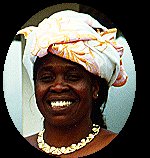
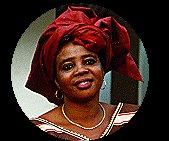
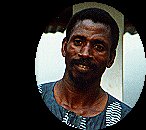
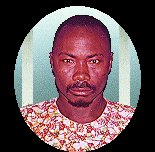
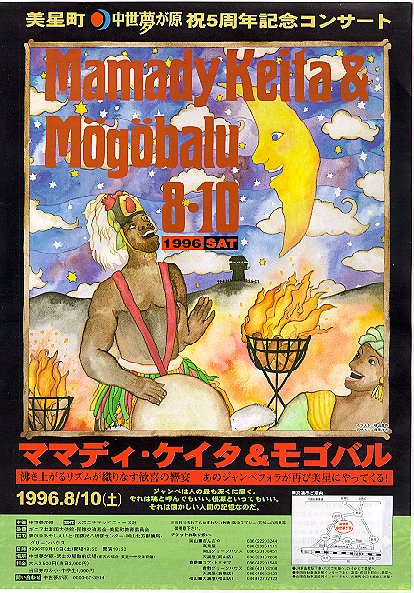
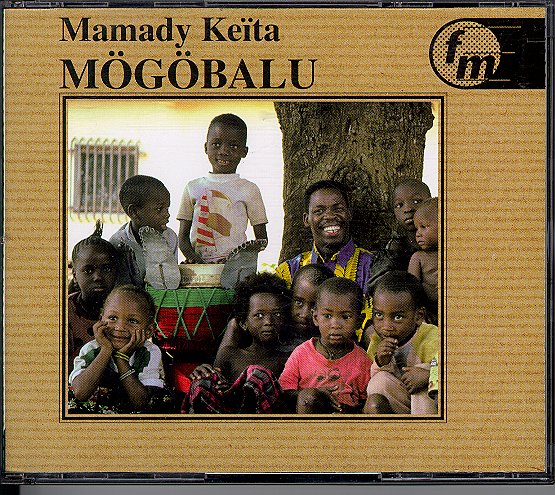
According to his autobiographical film, " Djembéfola ", Mamady formed a group
with the masters and companions of his formative years and his youth.
This is the meaning of the name
MÖGÖBALU
which signifies the sages, or masters.
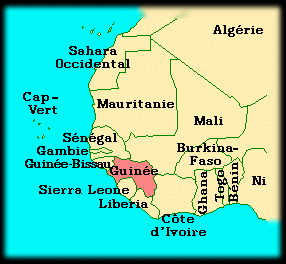
Guinea The mandingue homeland
| Guinea
is located in West-Africa.
The mande homeland, populated by the malinkés, as well as other ethnic groups, is a region covering Burkina Faso, Ivory Coast, the Gambia, Guinea (Conakry), Guinea Bissau, Liberia, Mali, Senegal and Sierra Leone. |
![]() |
The instruments played are from the Mandingue musical tradition.
![]() |
Today, the
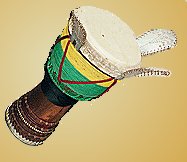
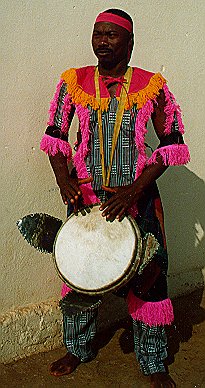
djembé is found
in many regions of West Africa and not only among the Mande peoples.
It is a goblet-shaped drum that is open at both ends, one of which
is covered with a goat skin and played with bare hands.
It functions both as a solo instrument and as an accompaniment instrument. The different methods of striking the skin result in a variety of tones that cover a broad range of the sound spectrum. |
|
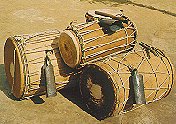
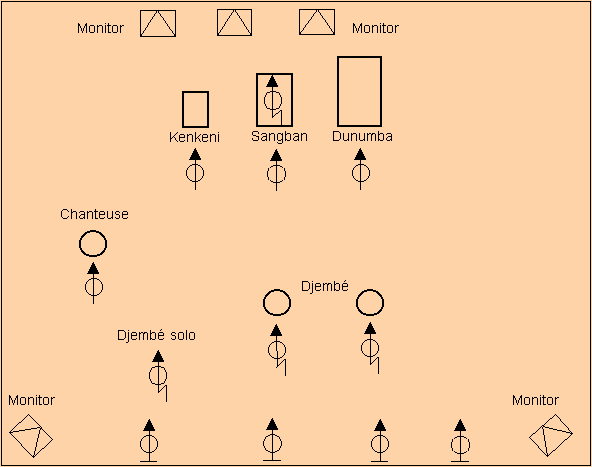
The foundation of a rhythm is imparted by a group of two or three cylindrical drums, each covered with two skins, which are commonly called dunum. They are played horizontally with a large stick. Mounted on top of each dunum is a metal bell that the musician strikes with an iron rod or a large bolt. The Dunumba, the largest of the dunum, emits the lowest note. Then comes the sangban, which is a little smaller, and then the kenkeni, which is the smallest of the three. One or two djembes, often having a lower pitch than the lead drummer's djembe, complete the ensemble. |
![]() |
![]() |
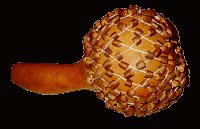
Joining the voices of the drums are the JABARA, which is a gourd that is covered by seeds or beads, and the KIRIN, which is a hollowed tree-trunk that is hit with sticks. |
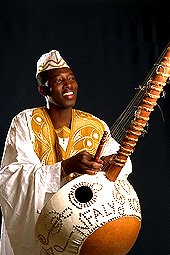
Besides the drummers, other musicians play the foulé flute, the bala, the kora and the bölön.
|
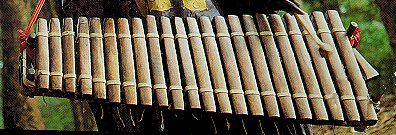
The bala (xylophone) used here has 27 keys tuned to an equidistant heptatonic scale. |
![]() |
![]() |
The kora is a kind of stringed harp that is very popular in West Africa, particularly in the Casamance region. It has twenty-one strings that are arranged along a grooved bridge. The strings of the kora are now made from nylon instead of the animal gut that was used in the past. It is the instrument, par exellence, of the griots. |
|
The bölön has a similar form, but without a bridge. It has a much shorter neck and only three or four thick strings that produce very low-pitched sounds. It is used by the griots to sing the praises of nobles who have accomplished remarkable exploits. |
|
The foulé flute is a transverse flute with three holes and is popular with the Malinké of Upper Guinea. Like the bölön, its usage is reserved for the songs extolling the authors of memorable deeds. Its body is made from a stem of a dried fern. It is tuned to the same musical scale as the bala, and nowadays the two instruments are often played together. |
| Primarily intended
to support dance, this percussion music is profoundly polyrhythmic.
Each drum plays its own part and the combination of parts forms a rhythmic and melodic foundation, due to the harmony of the different instruments and the different types of stroke used. This foundation gives the soloists a reference point upon which they can develop their improvisations. It is important to note that the word "rhythm" is generally used to designate the polyrhythmic ensemble of parts, but it can also mean the entire piece of music. The symbiosis between dance and music is perfect and both the musical and choreographic movements obey subtle codes that the spectator often has difficulty recognizing. The female griots have two roles: first, they sing the words that accompany the dance being performed, and second, they eulogize those people deserving praise from among the audience and among the musicians. This part, called mmatögöli (flatteries), allows the singer to show her improvisational talent and also determines the level of compensation she expects. Each griot is assisted by chorus singers who repeat phrases from the song. They mark the rhythm by striking the karignan, an iron tube, with an iron rod that is twenty centimeters long. |
![]() |
|
Famoudou KONATE |
He was born in 1940 near Kouroussa. His exceptional rhythmic talent appeared at a very early age. When he first performed he was too small to carry his drum by himself; the dancers had to give him a hand. In 1959 Guinea took the best musicians and dancers in the country to form the Ballets Africans of Guinea. Famadou Konate was chosen to be the lead drummer, a position that he occupied for 26 years. Since 1987 Famoudou has gone to Germany every year to give concerts and workshops to an ever growing audience. |
|
Mamady Keita is a
percussionnist master of international level. |
Mamady KEITA |
| She was born
on June 13, 1949 in Bissikirima into a family of griots from Mali. With
a special gift for singing, she began her career at age 10 with her
father and mother, both of whom were griots.
In 1963 she became a member of the Dabola orchestra, "Tinkisso Jazz". In 1967 she joined Oumou Kouyaté in the traditional instumental ensemble of Kissidougou. Her career as a lead vocalist first began in 1970 in Sierra Leone with the ensemble of the renowned Papa Kouyaté. In 1983 she formed her own group at Burkina Fasso and then at Cotonou. After touring for 2 years, she sang with the instrumental ensemble "Mande Nyaga," founded by Djelima Moudou Kanté of Conakry. In 1994 she became the lead vocalis of the Ballet "Soleil d'Afrique." |
Domani Damba KOUYATE |
![]() Mansy Diawara |
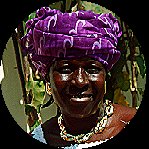
She was born in 1951 in Corrérah Boké. She began performing in 1976 in Conakry with the symphonic ensemble of the Republic of Guinea as a lead vocalist and dancer. She also toured the world with that ensemble. |
|
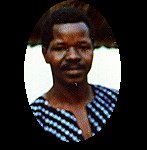
He was born in 1952 in Kouroussa. Daouda began playing at the age of 13. At age 17 he entered the National Ballet of the Guinean army as a dancer and a percussionist. He has been the lead drummer of the Ballet for four years. He has traveled 3 times to Germany with Famoudou Konaté and became a member of the latter's group: Hamana Diara. |
![]() Daouda Kourouma |
![]() Mamadouba Camara |
He was born in 1953 in Khabita Mayokhun. In 1974 he was a drummer with the Bouramaya-Wossou troupe. He joined the Dubréka troupe in 1975. Two years later he became a member of the National Ballet of the Guinean Army, and then in 1988 he joined the Djoliba National Ballet. |
|
Fanta KANTE was born in 1955 in Kissidougou. In 1966 she became part of the musical ensemble of Kissidougou. From 1969 to 1981 she worked in Freetown (Sierra Leone) with the National Information Service. From 1981 to 1990 she lived in Lomé, Togo. As a performing artist, she has traveled throughout Africa: Cameroon, Central Africa, Gabon, Zaire, Ivory Coast, the Gambia, Nigeria. |
Fanta KANTE |
|
|
Sékou Konaté was born in 1959 in Kouroussa. In 1987 Sékou joined the Ballet of the Guinean Army, where he has been a drummer for 9 years. He became part of Famadou Konaté's group, Hamana Diara. |
| He was born in 1962
in Kouroussa.
Mamady played for 6 years in the National Ballet of the Guinean Army. He was part of Famadou Konaté's group, Hamana Diara, for 2 years. |
|
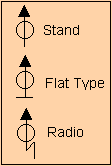
| Input | Mic |
Stand |
![]() |
|
1 |
Pick up stage |
PCC-200 |
Non |
|
2 |
Pick up stage |
PCC-200 |
Non |
|
3 |
Pick up stage |
PCC-200 |
Non |
|
4 |
Pick up stage |
PCC-200 |
Non |
|
5 |
Kenkeni |
MD-421 |
Boom |
|
6 |
Sangban |
MD-421 |
Boom |
|
7 |
Dunumba |
M-88 |
Boom |
|
8 |
Solo |
Hand Type Radio |
Boom |
|
9 |
Chanteuse 1 |
SM-58 |
Boom |
|
10 |
Mamady |
Small Head Radio |
Non |
|
11 |
Sangban |
Small Head Radio |
Non |